
CALL FOR PAPERS
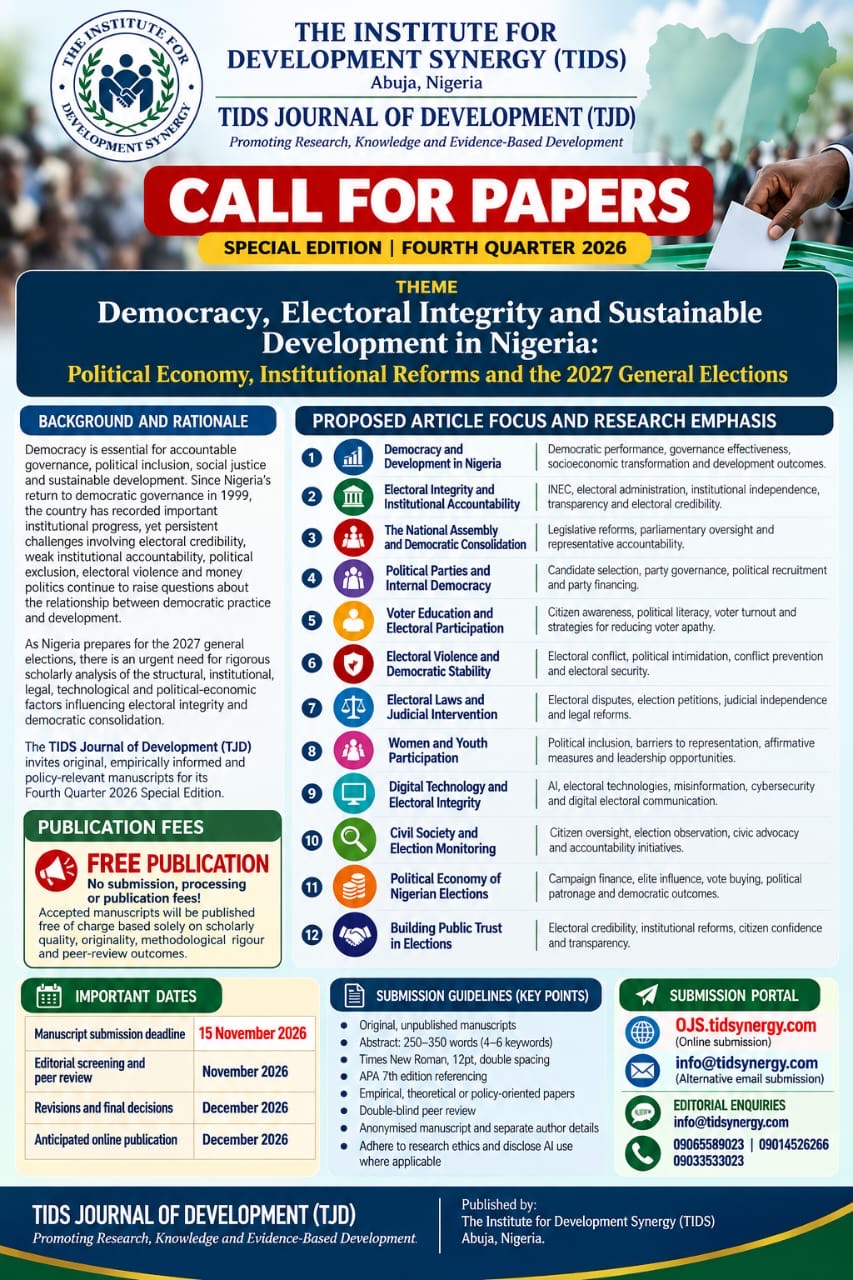
TIDS JOURNAL OF DEVELOPMENT (TJD)
Special Edition | Fourth Quarter 2026
Theme
Democracy, Electoral Integrity and Sustainable Development in Nigeria: Political Economy, Institutional Reforms and the 2027 General Elections
Background and Rationale
Democracy is widely recognised as an important institutional framework for promoting accountable governance, political inclusion, social justice and sustainable development. However, the developmental benefits of democracy depend substantially on the credibility of electoral processes, the effectiveness of democratic institutions, the quality of political leadership and the capacity of citizens to hold public officials accountable.
Since Nigeria's return to democratic governance in 1999, the country has recorded important political and institutional developments. Nevertheless, persistent challenges involving electoral credibility, declining public confidence, political exclusion, weak institutional accountability, electoral violence, money politics and governance deficits continue to raise fundamental questions about the relationship between democratic practice and sustainable development.
As Nigeria prepares for the 2027 general elections, there is an urgent need for rigorous scholarly interrogation of the structural, institutional, legal, technological and political-economic factors influencing electoral integrity and democratic consolidation.
Against this background, the TIDS Journal of Development (TJD) invites original, theoretically grounded, empirically informed and policy-relevant manuscripts for its Fourth Quarter 2026 Special Edition.
The edition seeks to advance critical scholarship, generate actionable policy recommendations and contribute to national conversations on strengthening Nigeria's electoral institutions, democratic accountability and developmental governance.
Proposed Article Focus and Research Emphasis
Contributors are invited to submit manuscripts addressing, but not limited to, the following thematic areas:
- Democracy and Development in Nigeria
Research emphasis: Democratic performance, governance effectiveness, socioeconomic transformation and sustainable development outcomes.
- Electoral Integrity and Institutional Accountability
Research emphasis: INEC, electoral administration, institutional independence, transparency and mechanisms for strengthening electoral credibility.
- The National Assembly and Democratic Consolidation
Research emphasis: Legislative reforms, parliamentary oversight, representative accountability and the contribution of the legislature to democratic development.
- Political Parties and Internal Democracy
Research emphasis: Candidate selection, party governance, political recruitment, party financing and institutionalisation of internal democratic practices.
- Voter Education and Electoral Participation
Research emphasis: Citizen awareness, political literacy, voter turnout, electoral participation and strategies for reducing voter apathy.
- Electoral Violence and Democratic Stability
Research emphasis: Electoral conflict, political intimidation, conflict prevention, electoral security and peacebuilding mechanisms.
- Electoral Laws and Judicial Intervention
Research emphasis: Electoral disputes, election petitions, judicial independence, legal interpretation and electoral justice reforms.
- Women and Youth Participation
Research emphasis: Political inclusion, barriers to representation, affirmative measures, leadership opportunities and equitable electoral participation.
- Digital Technology and Electoral Integrity
Research emphasis: Artificial intelligence, electoral technologies, misinformation, disinformation, cybersecurity and digital electoral communication.
- Civil Society and Election Monitoring
Research emphasis: Citizen oversight, election observation, civic advocacy, accountability initiatives and civil society contributions to credible elections.
- Political Economy of Nigerian Elections
Research emphasis: Campaign finance, elite influence, vote buying.
Guidelines for Contributors
The journal welcomes high-quality manuscripts within the broad field of development studies, including but not limited to the following thematic areas:
- Manuscripts must be original, unpublished, and not under consideration for publication elsewhere.
- Submissions must be accompanied by an abstract of not more than 250 words.
- Manuscripts should be typed in Times New Roman, font size 12, with 1.5 line spacing.
- Manuscripts should be between 6,000 and 8,000 words, including references.
- All references must conform to the American Psychological Association (APA) Style, 7th Edition.
- Manuscripts must be written in English.
- Each manuscript should include the following details:
- Title of the paper
- Full name(s) of author(s)
- Institutional affiliation(s)
- Telephone number(s)
- Email address(es)
All submissions will undergo a rigorous double-blind peer-review process, ensuring that the identities of both authors and reviewers remain anonymous throughout the review process.
Submission and Deadline
All manuscripts should be submitted electronically to:
Online submission: ojs.tidsynergy.com
Email: info@tidsynergy.com
Manuscript Submission Deadline: 15th November 2026
Revisions and final decisions: December, 2026
Authors are advised to ensure that manuscripts comply fully with the journal’s formatting and referencing requirements before submission.
Enquiries
For further enquiries, please contact:
Email: info@tidsynergy.com
Phone: 09014526266, 08037094895, 09065589023
Website: www.tidsynergy.com
The Institute for Development Synergy looks forward to receiving quality submissions that contribute meaningfully to development research, policy innovation, and practical solutions for sustainable development.